
This year, Merdeka Day falls on a weekday, Tuesday to be exact and so we had a day off in the middle of the week. My colleague Lum, her hubby Mathew and neighbour Lim...and I of course went for a try on the newly opened Raub - Betau/Bertam Valley link road to Ringlet at the Cameron Highlands.
We started early from Kl so as to have a leisurely drive as well as trying to get good birding time at the mountains. After a breakfast pit stop in Raub, we drove to Kuala Medang. This quaint village has home stay programmes as well as boating facilities to explore the Jelai River and her tributaries. After some photos and some birds, off we went: direction Pos Betau - Bertam Valley - Ringlet - Tanah Rata - Brinchang - Sungei Palas - Mossy Jungle at the peak of Mount Brinchang (6 666 feet above sea level). On the way, we spotted 2 beautiful black eagles on a Tualang tree just after Pos Betau. Having spent quite some time on pit stops and birding along the way, we decided to head straight to the Mossy jungle trail near the peak of Gunung Brinchang with the promise of interesting wildlife spectacles (oops...we actually had lunch first at Ringlet). We were greeted by heavy mist at the peak and the temperature must have been hovering at around 14 - 18 degrees because I started to get chills even with my long-sleeved polo on. We saw some very interesting highland birds like the Niltava (beautiful blue bird) and the Barbet (learning birding vocab here...) as well as many interesting montane plants that I have not seen before. I even spotted a clump of flowering Rhododendron Scortechinii along the way back! The thick mist impart an exotic and out-of-this-country experience and had a decidedly eerie tone to it. Luckily, steps and railings were set along the paths to guide the randonneurs (trekkers) and is, in my opinion, perfect to keep trekkers off the possibilities of getting lost in the misty cloud forest. Unfortunately, the construction had to include the sacrifice of many trees and mossy patches along the way.
Sans realizing the passing of time as we were totally absorbed by the experience until the watch showed it was time to leave (nearing 5 p.m.). We made another pit stop on the way down at Sungei Palas before deciding on dinner at Ringlet and before we knew it, nightfall came. The drive down the mountains was slow and we reached Kl almost midnight...tired but fulfilled.
We started early from Kl so as to have a leisurely drive as well as trying to get good birding time at the mountains. After a breakfast pit stop in Raub, we drove to Kuala Medang. This quaint village has home stay programmes as well as boating facilities to explore the Jelai River and her tributaries. After some photos and some birds, off we went: direction Pos Betau - Bertam Valley - Ringlet - Tanah Rata - Brinchang - Sungei Palas - Mossy Jungle at the peak of Mount Brinchang (6 666 feet above sea level). On the way, we spotted 2 beautiful black eagles on a Tualang tree just after Pos Betau. Having spent quite some time on pit stops and birding along the way, we decided to head straight to the Mossy jungle trail near the peak of Gunung Brinchang with the promise of interesting wildlife spectacles (oops...we actually had lunch first at Ringlet). We were greeted by heavy mist at the peak and the temperature must have been hovering at around 14 - 18 degrees because I started to get chills even with my long-sleeved polo on. We saw some very interesting highland birds like the Niltava (beautiful blue bird) and the Barbet (learning birding vocab here...) as well as many interesting montane plants that I have not seen before. I even spotted a clump of flowering Rhododendron Scortechinii along the way back! The thick mist impart an exotic and out-of-this-country experience and had a decidedly eerie tone to it. Luckily, steps and railings were set along the paths to guide the randonneurs (trekkers) and is, in my opinion, perfect to keep trekkers off the possibilities of getting lost in the misty cloud forest. Unfortunately, the construction had to include the sacrifice of many trees and mossy patches along the way.
Sans realizing the passing of time as we were totally absorbed by the experience until the watch showed it was time to leave (nearing 5 p.m.). We made another pit stop on the way down at Sungei Palas before deciding on dinner at Ringlet and before we knew it, nightfall came. The drive down the mountains was slow and we reached Kl almost midnight...tired but fulfilled.
 The bridge that spans the Jelai River to Tanjung Gahai.
 Moored motorized sampan at the banks of the Jelai River at Kuala Medang.
 A butterfly 'drinking' off a mud patch - the Common Rose, Pachliopta aristolochiae
 Wild passion fruits dangling off the branches of a huge Bungor tree.
 Passion fruits.
 Neram trees on the banks of the Ulu Jelai River.
 View of the Betau Valley from the highway.
 Hive of the Giant Asiatic Honey Bee on the branch of a tall Tualang tree.
 A pair of black eagles on the same tree. (picture courtesy of Lim Yau Tong from his page at picasaweb)
 rapids...
 Freshly dug bamboo shoots on sale.
 Petai, or sting beans. Smelly and anti-social food but mildly diuretic and good for the kidneys.
 Semai woman preparing the bamboo shoots...
 The Semai vendors along the road at Bertam...
 Orang Asli settlement...
 Newly constructed retaining walls that bleed laterite stained effluents from the disturbed hills after a rainfall.
 Vegetable patch. Thousands of acres are exploited for agriculture on this sensitive environment that includes the headwater of the Telom River, one of the main tributaries that made up the Jelai River system which in turn feeds the Pahang River, the biggest river of the peninsular. Will we ever learn from past mistakes? Never.
 Ringlet town.
 Still hungry for more land...at Ringlet.
 Nice dish of stir-fried vege, called Dragon's whiskers in chinese but actually the tendrils and young shoots of the chayote, called christophene in French.
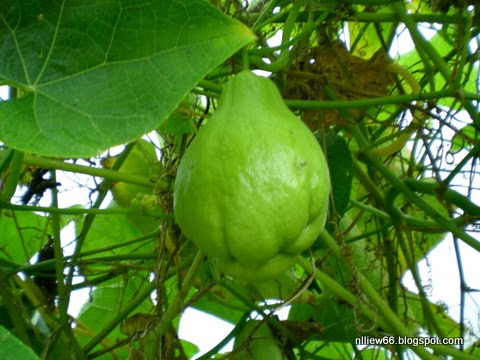 The fruit of the chayote...
 Plants from Mount Brinchang.
 Misty forest...
 The pathways...
 Nice bird...
 Lycopodium spp. on a mossy branch.
 Mosses on trunks of trees on the heath forest.
 A patch of spaghnum moss.
 Wild raspberries.
 Flowering spath of an arum lily.
 fire-cracker plant.
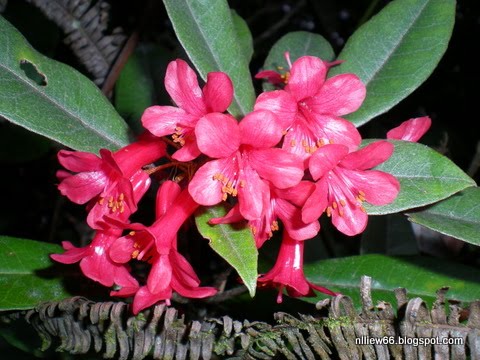 Beautiful pink rhododendrons.
 The happy birders.
 View from the observation tower at the peak of Mount Brinchang.
 Misty...
 Liparis orchid.
 Baby pitcher plant.
 Beautiful light-pink Dendrobium spp.
 Impatiens riddleyi -the mountain balsam.
 A patch of Begonias.
 Blue berries...
 View of Sungei Palas tea estate - still owned by the Russell Family of the founder.
 Like airstrips in the dark, lighted greenhouses for chrysanthemums illuminate the eerie highland nights along the newly opened Bertam Valley link road to Raub and Kuala Lipis...


